
Main Menu
Export
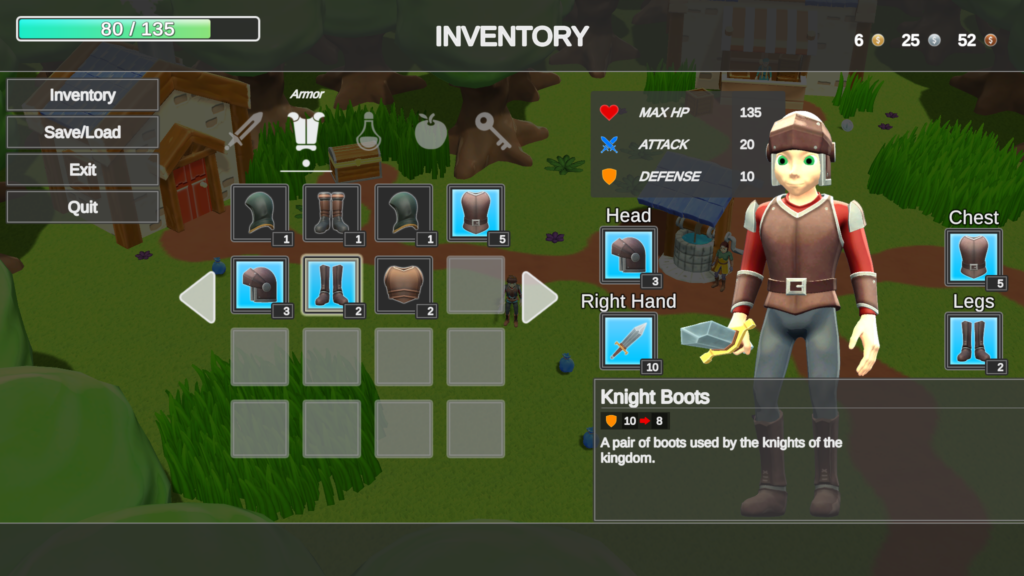
Use Main Menu as the navigation shell for Inventory panels that should share one screen. A typical menu opens Bag first, switches to Equipment, and can later add Shop, Crafting, or Save/Load without opening several overlapping menus.
Main Menu is optional. Keep a world interaction such as Chest in its own menu when it should open independently rather than appear as a permanent Inventory tab.
Before you begin
Confirm that:
- the intended Inventory System Database is selected in Main Manager > Setup;
- Canvas Managers exist and a duplicated UI Designer schema has been spawned in the scene;
- the scene has an EventSystem and a Display Panel Manager;
- the player has an Inventory with Bag and Equipment Item Collections;
- Equipment is an Item Slot Collection with a Weapon slot that accepts Iron Sword; and
- Health Potion and Iron Sword have the Icon and Description values required by their Item Views.
Most spawned schemas already include a Main Menu. Check the Display Panel Manager’s Main Menu Panel reference and the scene hierarchy first. When one exists, select it under Edit instead of creating a second menu.
Set the panel owner
On the Display Panel Manager:
- Assign the player GameObject to Panel Owner. This is the clearest choice for a single-player scene.
- Alternatively, leave Panel Owner unassigned and set Panel Owner Inventory Identifier ID to the player’s Inventory Identifier ID.
- Assign the normal in-game panel to Gameplay Panel before creating Main Menu when UI Designer should add a Main Menu opening button there.
Inventory panels with Bind To Panel Owner Inventory enabled use the Inventory on this GameObject. If Panel Owner is missing and its Inventory Identifier cannot be found, the Display Panel Manager disables its UI at initialization.
Create the Main Menu
Create a menu only when the spawned schema does not already provide the intended one:
- Open Tools > Opsive > Ultimate Inventory System > UI Designer.
- Select the Main Menu tab and open Create.
- Set Parent Transform to a Rect Transform below the intended Display Panel Manager.
- Set Panel name to a unique, descriptive value such as
Inventory Main Menu. - Enable Vertical for the schema’s vertical tab prefab, or disable it for the horizontal tab prefab.
- Select Create.
- Confirm that the Display Panel Manager’s Main Menu Panel now references the generated Display Panel.
- If Gameplay Panel was assigned, confirm that its main content contains the generated Main Menu Action Button.
Creating another Main Menu replaces the manager’s Main Menu Panel reference but does not automatically remove an older menu or opener. Prefer editing the schema’s existing menu unless a replacement is deliberate.
Add Bag and Equipment
Add each subpanel from its own UI Designer tab. This creates both the panel and its mapped Main Menu button.
Add Bag
- Select Inventory Grid.
- Set Parent Transform to the Main Menu Display Panel’s Main Content transform.
- Set Panel Option to Main Menu.
- Set Panel Name and Inventory Grid Name to
Bag, then assign the player Inventory. - Create the grid and configure its collection filter to show Bag while excluding Equipment.
Add Equipment
- Select Equipment.
- Use the same Main Menu Main Content as Parent Transform.
- Set Panel Option to Main Menu and Panel Name to
Equipment. - Assign the player Inventory and the Item Slot Set used by the Equipment Item Collection.
- Create the Item Slot Collection View, set its Item Collection ID to Equipment, and confirm that its Weapon slot accepts Iron Sword but rejects Health Potion.
At this checkpoint, the Main Menu should contain two inner Display Panels and two tab buttons. Bag and Equipment should also appear as paired Panel and Button entries on the Main Menu component.
Add related panels
Use the same Main Menu Parent Transform and Panel Option for other persistent navigation destinations:
| Panel | Add it when | Expected data |
|---|---|---|
| Shop | Buying or selling belongs inside the shared menu | Shop Inventory, Gold, and Item price attributes |
| Crafting | Players should choose recipes from the shared menu | Crafter, Crafting Categories, and the Health Potion recipe |
| Save/Load | The built-in slot menu belongs inside the shared menu | Save System Manager and required Saver components |
| BlankSubPanel | A project-specific page has no dedicated UI Designer tab | Custom content added manually after generation |
Item Description, Currency views, and other supporting UI normally belong inside the panel that supplies their data rather than becoming empty tabs of their own.
Manage subpanels and buttons
- In the Main Menu Edit section, select the intended Main Menu.
- Review Main Menu Sub Panels. Each entry represents one runtime Panel/Button pair.
- Select an entry and compare its displayed Panel name and Button text.
- Use Select Panel and Select Button to locate the exact generated objects before changing their layout or text.
- Use the add control only when a custom blank panel is needed. It creates a
BlankSubPanelDisplay Panel and matching button. - Remove an entry only when both its panel and button should be deleted; removal destroys both generated objects and their Main Menu reference.
Keep every Panel and Button reference non-null. Give every Display Panel a unique Unique Name, and make its button text describe the same destination.
New subpanel buttons are inserted at the start of the Menu Tabs hierarchy, while their Panel/Button mappings are appended to Main Menu Sub Panels. After adding several panels, deliberately align the visual button order and the list order. The list determines which panel is first and which panel is remembered as previous; the hierarchy determines how the buttons appear on screen.
Choose what opens first
Set Menu Open Options on Main Menu:
| Option | Result | Use it when |
|---|---|---|
| Open Previous Sub Menu | Reopens the last selected panel | Players should return to their recent context |
| Open First Sub Menu | Opens index 0 in the Panels list | Bag should always be the starting page |
| Open No Sub Menu | Opens the shell with every subpanel closed | The player should explicitly choose a destination |
For the standard Bag and Equipment workflow, place Bag at index 0 and choose Open First Sub Menu. Confirm that the visually first button is also Bag after matching the list and hierarchy order.
On Main Menu, also confirm that Close Button, optional Quit Button, and Menu Tabs reference the intended generated controls. Quit calls Application.Quit, so it has no visible effect while testing inside the Unity Editor.
Choose manager behavior
The Display Panel Manager controls the transition between gameplay and menu panels:
- Enable Set Time Scale To Zero When Menu Is Opened when opening Main Menu should pause scaled gameplay.
- Enable Close Menu When Opening Another when a new menu should close the current menu. When disabled, the manager refuses to open the second menu while another menu is active.
- Enable Enable Input On Gameplay Selected when selecting and leaving Gameplay Panel should toggle gameplay input events on the Panel Owner.
Choose these settings for the entire panel manager rather than per subpanel. Bag and Equipment are inner panels of the same Main Menu, so switching between them does not open a second menu.
How it runs
- Display Panel Manager opens its Main Menu Panel and closes the selected Gameplay Panel when Main Menu is a menu panel.
- Main Menu applies Menu Open Options and opens the selected inner panel.
- Pressing the Equipment button closes and deactivates every other mapped subpanel, then opens Equipment.
- Pressing Bag repeats the same process in the other direction.
- Closing Main Menu closes its selected subpanel and returns focus to the previous panel or selectable.
Each generated button is paired with its panel at initialization. This is why a non-null mapping and consistent order matter more than the button’s visible position alone.
Editor checkpoints
Before entering Play Mode, confirm that:
- the scene has an EventSystem, and the Display Panel Manager resolves the intended player through Panel Owner or Panel Owner Inventory Identifier ID;
- Gameplay Panel and Main Menu Panel reference the intended Display Panels;
- only one active Main Menu and one intended gameplay opener exist;
- the Main Menu Display Panel has a unique name and is configured as a menu panel;
- Close Button, Menu Tabs, and every Panel/Button pair have valid references;
- Bag and Equipment are children of the Main Menu’s Main Content;
- Bag is index 0 when Open First Sub Menu is selected;
- the Menu Tabs hierarchy and Main Menu Sub Panels list use the same intended order;
- Bag binds to the player Inventory and filters out Equipment;
- Equipment binds to the same Inventory, Item Collection ID, and Item Slot Set used at runtime; and
- every related panel has the data it needs before its tab is exposed to players.
Verify in Play Mode
- Enter Play Mode and use the generated gameplay button or the project’s menu input to open Main Menu.
- Confirm that Bag opens first and shows Health Potion and Iron Sword while hiding Items already in Equipment.
- Move to Equipment using pointer, keyboard, and controller input. Confirm that Bag closes, Equipment opens, and selection remains visible.
- Equip Iron Sword and confirm that it leaves Bag and appears in the Weapon slot without changing the active Main Menu shell.
- Return to Bag and confirm that both panels display the updated Inventory state.
- Close Main Menu. Confirm that the selected subpanel closes, Gameplay Panel returns, and the configured time-scale and gameplay-input behavior are restored.
- Reopen the menu and confirm that Menu Open Options chooses Bag, the previous panel, or no panel exactly as configured.
- If Shop, Crafting, or Save/Load is included, open each tab and verify its data workflow independently.
- Try to open another standalone menu while Main Menu is active and confirm that Close Menu When Opening Another applies the intended close-or-refuse policy.
Troubleshooting
- The entire UI disables itself on start: Assign Panel Owner, or correct Panel Owner Inventory Identifier ID so it resolves an Inventory Identifier at initialization.
- No Main Menu opening button was created: Assign Gameplay Panel before creating Main Menu. Otherwise, add a project button that calls the generated Main Menu Display Panel’s open flow.
- Main Menu does not open: Check Main Menu Panel, confirm that the panel is registered under the intended Display Panel Manager, and check whether another menu is blocking it.
- A second Main Menu opens instead of the intended one: Check for an older generated menu and opener, then keep one deliberate Main Menu Panel reference.
- A tab opens the wrong panel: In Main Menu Sub Panels, compare each Panel name and Button text, then use Select Panel and Select Button to repair the mismatched pair.
- The wrong panel opens first: Check Menu Open Options and the Panels list order.
Open First Sub Menuuses list index 0, not the visually first hierarchy child. - A new panel does not appear as a tab: Its Panel Option must be Main Menu, and its Parent Transform must be this Main Menu’s Main Content.
- The tab order looks reversed after adding panels: UI Designer inserts new buttons at the start of Menu Tabs but appends their mappings to the list. Reorder the button hierarchy and Main Menu Sub Panels list to match.
- Bag is empty or shows the wrong player: Check the Display Panel Manager’s Panel Owner, the panel’s Inventory binding, and the Bag Item Collection filter.
- Equipment shows the wrong slots or rejects Iron Sword: Check the Equipment Item Collection, Item Collection ID, shared Item Slot Set, and the Weapon restriction.
- Several subpanels remain visible: Confirm that every destination is included in Main Menu’s Panels list and that each entry references the intended inner Display Panel.
- Keyboard or controller focus is lost: Check the EventSystem, each Display Panel’s Selectable On Open, Action Button navigation, and the selected schema’s Menu Tabs layout.
- Gameplay remains paused or input remains disabled: Confirm that Main Menu actually closes, then check Set Time Scale To Zero When Menu Is Opened and Enable Input On Gameplay Selected on the same Display Panel Manager.
- A duplicate panel-name warning appears: Give each Display Panel a unique Unique Name before the manager registers it.
- Quit appears to do nothing:
Application.Quitdoes not stop Play Mode in the Unity Editor; test it in a built player.