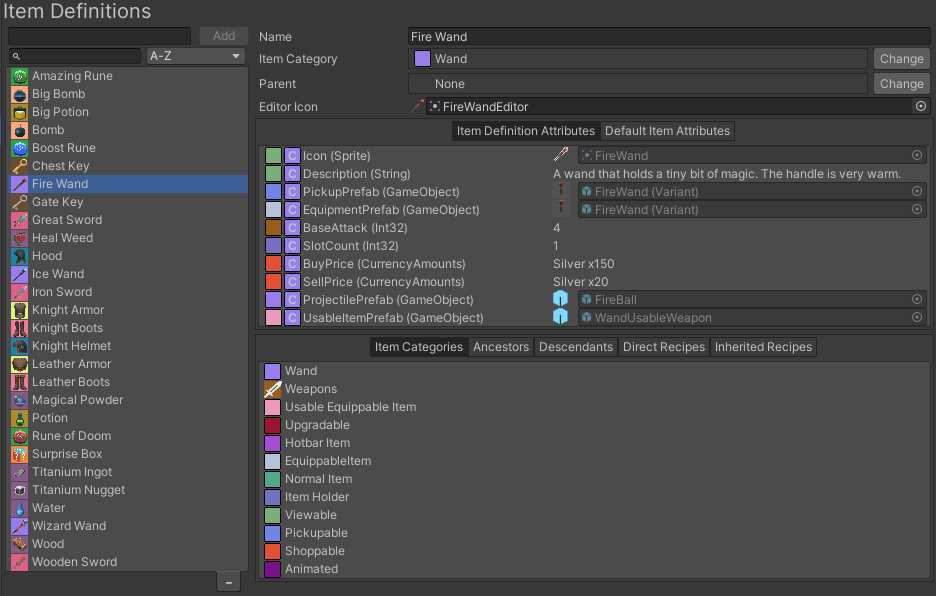
Create an Item Definition for each reusable Item type the game can produce, such as Health Potion, Iron Sword, or Fire Wand. Build the Item Category structure first: a definition must use a category, and that category determines which definition and runtime Item attributes are available.

Before you begin

Confirm that the selected Inventory System Database contains:

  • All > Consumable and All > Equippable > Weapon.
  • Icon, Description, and BuyPrice in All’s Item Definition attribute collection.
  • Attack in Weapon’s Item Definition collection.
  • Durability in Weapon’s Item collection.
  • Weapon configured as mutable and unique when every runtime weapon must retain its own Durability.

If those declarations are not ready, configure them in the Item Category editor before adding definitions.

Create Health Potion

  1. Open Tools > Opsive > Ultimate Inventory System > Main Manager.
  2. In Setup, confirm that the intended Inventory System Database is selected.
  3. Open Item Definitions.
  4. Enter Health Potion beside Add and create it. A new definition initially uses Uncategorized.
  5. In Properties, set Item Category to Consumable.
  6. In the definition’s Attributes section, set Icon, Description, and BuyPrice to Health Potion values.
  7. Leave Weapon-only fields absent. Health Potion should not receive Attack or Durability because Consumable does not inherit from Weapon.

At this checkpoint, Health Potion should show Consumable as its direct category and All as an inherited category.

The Item Definition editor showing the definition list and the selected definition's Properties, Attributes, and Relationships sections.

Create Iron Sword

  1. Add Iron Sword and set Item Category to Weapon.
  2. In the Item Definition attributes, set Icon, Description, BuyPrice, and Attack.
  3. Open the Default Item attributes and set the starting Durability.
  4. Confirm that the source of the common declarations is All and the source of the weapon declarations is Weapon.

The Default Item supplies the initial Item-level values for runtime Items created from this definition. When the Item is mutable, the system duplicates the Default Item so each runtime Iron Sword can keep its own Durability.

Create Fire Wand efficiently

  1. Right-click Iron Sword in the definition list and choose Duplicate.
  2. Rename the copy Fire Wand. The definition name must remain unique and also identifies its Scriptable Object file.
  3. Keep Item Category set to Weapon.
  4. Replace the copied Icon, Description, BuyPrice, and Attack values with the Fire Wand values.
  5. Set the Fire Wand Default Item’s starting Durability.

Duplicating is useful when definitions share a category and most fields, but the duplicate is still an independent definition. Review every overridden value so the copied definition does not retain an Iron Sword asset or description by mistake.

Choose definition properties

Property Decision Standard example
Name Use a unique, player-recognizable definition name. Iron Sword
Item Category Choose the narrowest direct category that supplies the required fields and mappings. Weapon, not Equippable or All
Parent Use another definition only for a true variation with the same Item Category. Iron Sword +1 can inherit from Iron Sword
Editor Icon Set an editor-only icon when it should differ from the inherited Icon attribute. Leave empty to use Icon

Changing Item Category rebuilds the fields available to the definition and its Default Item. Values from the previous category can be removed when no matching declaration exists in the new category, so confirm the category before entering substantial data.

Decide whether to use a parent definition

A parent definition must use the same Item Category as its child. Use a parent for a variation that should inherit most values, such as Iron Sword +1 inheriting from Iron Sword and changing only Attack or BuyPrice.

Do not make Fire Wand a child of Iron Sword merely because both use Weapon. They are separate Item types and already share their structure through the Weapon category.

For a child definition, choose the Variant for each value deliberately:

  • Inherit keeps the value from the parent definition.
  • Override stores a value specific to the child.
  • Modify derives a supported value from the inherited or another attribute value.

Parenting changes attribute inheritance from the Item Category value to the parent definition value. Use the Relationships section to inspect Ancestors and Descendants before relying on inherited data.

Use the Attributes and Default Item sections

The definition has two value contexts:

Context Use it for Standard example
Item Definition Values shared by every Item created from this definition Icon, Description, BuyPrice, and Attack
Default Item Starting values for Item attributes that can vary per runtime instance Durability on Iron Sword or Fire Wand

The Item Category editor owns the declarations. The Item Definition editor sets or inherits their values. If a field is missing here, add it to the correct attribute collection on the direct category or an ancestor rather than trying to create it on the definition.

Definition-specific behavior can also use an ItemActionSet Item Definition attribute when Items in the same broad category need different actions. For ordinary category-wide actions, use a Category Item Action Set instead.

Find definitions and use list actions

Use the list search tokens when the database grows:

  • a:<AttributeName> finds definitions containing the named attribute.
  • c:<ItemCategoryName> matches the direct Item Category name.
  • i:<ItemCategoryName> matches the direct category or an ancestor category. Both category searches use case-insensitive name matching.

Right-click a definition to access these supported workflows:

  • Duplicate creates an independent copy for a similar Item type.
  • Create Recipe creates an Uncategorized Crafting Recipe with quantity 1 of the selected Item Definition as its output, copies the Definition’s editor icon, and opens the new Recipe. Its ingredient list starts empty, so complete that workflow on the Crafting Recipe page.

The Relationships section lists Item Categories, Ancestors, Descendants, Direct Recipes, and Inherited Recipes. Use it to confirm the data path and navigate to related objects.

Editor checkpoints

Before entering Play Mode, confirm that:

  • Health Potion uses Consumable; Iron Sword and Fire Wand use Weapon rather than Uncategorized.
  • All three definitions expose Icon, Description, and BuyPrice.
  • Only Iron Sword and Fire Wand expose Weapon’s Attack and Default Item Durability fields.
  • Every copied value on Fire Wand has been reviewed and replaced where necessary.
  • Iron Sword and Fire Wand have no Parent unless they are intentionally part of a same-category variation chain.
  • Any child definition shows the expected inherited source and uses Override or Modify only for intentional differences.
  • Editor Icon is empty when the definition should use its Icon attribute in the editor.

Verify in Play Mode

  1. Add a stack of Health Potion Items, two Iron Sword Items, and one Fire Wand Item to the player’s Bag collection.
  2. Open the inventory UI and confirm that each definition displays its own Icon and Description.
  3. Confirm that the shop reads each definition’s expected BuyPrice in Gold when the shop is configured.
  4. Compare Iron Sword and Fire Wand and confirm that each reports its own Attack value.
  5. Change one Iron Sword’s Durability and confirm that the other weapon Items keep their own values.
  6. Confirm that matching Health Potion Items stack when the collection permits stacking.
  7. If a definition-specific ItemActionSet is configured, invoke the Item and confirm that the selected definition uses the intended action set.

Troubleshooting

  • A new definition remains Uncategorized: Set Item Category in Properties, then verify the expected inherited fields before entering values.
  • An expected attribute is missing: Check the direct Item Category and its ancestors, then add the declaration to the correct Item Definition or Item collection in the Item Category editor.
  • Values disappeared after changing category: The new category does not declare matching fields. Restore the correct category and re-enter any values that were removed.
  • A field cannot be edited: Check whether its Variant is Inherit. Use Override only when this definition should differ from its parent.
  • A Parent cannot be selected: Confirm that both definitions use the same Item Category and that the relationship would not create an invalid ancestry.
  • Two weapons share changing Durability: Keep Durability in the Item collection and confirm that Weapon is mutable and unique.
  • The editor shows the wrong icon: Check Editor Icon first, then inspect the definition’s Icon value and inherited source.
  • The wrong actions appear: Check the definition’s categories and the Category Item Action Set mappings, or the ItemActionSet value when using definition-specific behavior.