What is a Finite State Machine?
Finite State Machines (FSMs) are a technique commonly used in games to organize behavior into clear modes and control how systems transition between those modes. They are especially well suited for structured gameplay flow, predictable behavior, and systems that operate through distinct phases or states.
FSMs have been used in games for decades across AI, animation, gameplay systems, and user interfaces. Their enduring popularity comes from their simplicity and clarity: at any given time, a system is always in a single, well-defined state, making logic easier to understand, debug, and extend as projects grow.
State Control with States and Transitions
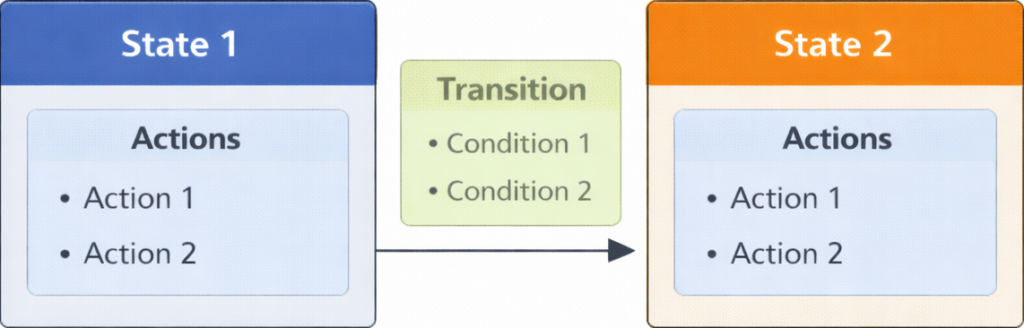
At their core, finite state machines are built from a collection of states connected by transitions. Each state represents a specific mode of behavior, such as patrolling, attacking, jumping, or reloading. While in a state, the system performs the logic associated with that mode. Transitions define the conditions or events that cause the system to move from one state to another. Together, states and transitions form a clear flow of execution that controls how behavior progresses over time.
How Finite State Machines Execute
Finite state machines operate by remaining in the current state until a transition condition is met. Consider a simple enemy FSM with three states: Patrol, Chase, and Attack.
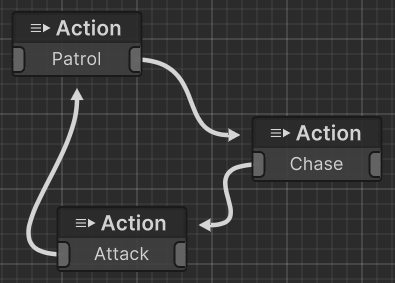
The enemy begins in the Patrol state and continuously looks for the player. When the player is detected, a transition moves the FSM into the Chase state. While chasing, if the enemy reaches the player, it transitions into Attack. If the player escapes, the FSM transitions back to Patrol. Instead of evaluating many possible actions at once, the FSM always knows exactly which mode of behavior is active, and flow is controlled by explicit transitions.
Rapid Iteration with Visual Flow
FSMs map naturally to visual graphs. States appear as nodes and transitions appear as connections between them, allowing you to see the entire flow of behavior at a glance. Adding new modes or altering flow often requires only adding a new state and connecting it with transitions. For example, if you want an enemy to flee when its health becomes low, you can add a Flee state and create a transition from Attack when health drops below a threshold. The rest of the system remains unchanged.
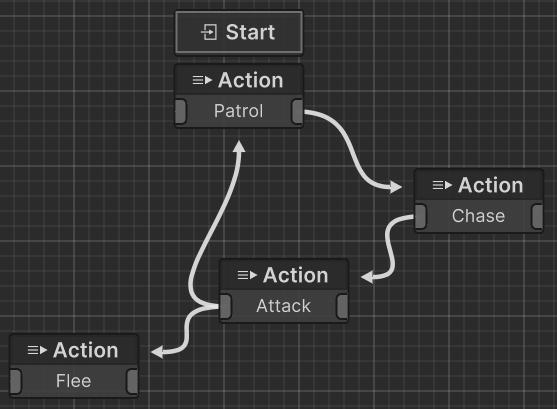
This makes FSMs extremely effective for designing gameplay flow and predictable behavior systems.
Real-Time Debugging and Inspection
Finite state machines are also easy to debug visually.
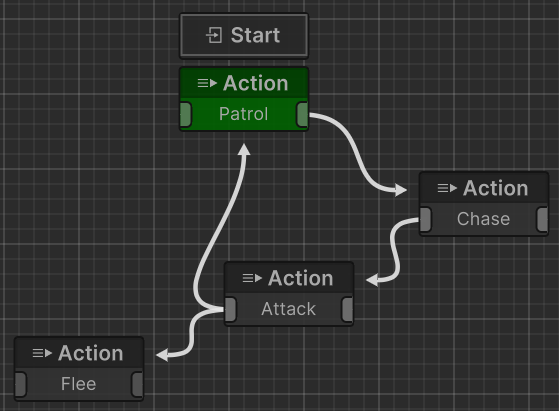
During runtime you can see which state is currently active and observe transitions as they occur. This makes it straightforward to understand why the system is behaving a certain way and quickly adjust logic when necessary. The clear separation of states helps isolate issues and maintain clean control flow as systems grow.
Where Finite State Machines Excel
Finite state machines work best for systems that require:
- Structured flow and sequencing.
- Stable modes of behavior.
- Explicit transitions between phases.
- Predictable execution.
They are particularly effective for animation systems, gameplay phases, boss fight progression, and any situation where behavior follows clear stages.
Finite State Machines with State Designer
State Designer is built specifically for creating scalable state-driven systems. It provides a powerful visual environment for designing states, defining transitions, and observing flow in real time. By focusing on state control and execution flow, State Designer makes it easier to build maintainable gameplay systems without relying on complex conditional logic in code.
Getting Started
When first working with finite state machines, it’s best to begin with simple state graphs and gradually introduce more complex transitions and logic. Start with basic movement or mode switching, then layer in additional states as your system grows. Over time, the same structure can support very complex gameplay flow.